Monday, May 6, 2013

Old School Cavalry Mounting

I have written before about the challenges of mounting a cavalry horse with weapons hanging off your body.  It is an activity that takes some practice and an understanding of the equipment you're using.  I have learned the hard way that you have to make sure your carbine sling is adjusted so that your rifle barrel doesn't hang down too far when you sling it over your back.  If the barrel hangs below your knees, you are likely to hook it with your right leg as you throw it up over your horse during mounting.  This mistake results in either the rider sitting on his own rifle, or worse, smacking the horse in the left hip with the rifle barrel, causing it to launch forward while the hapless rider still has only one foot in the stirrup.  There are other bad things that can happen during this activity and I have experienced them all. 

Thus, I was somewhat gratified to learn that our cavalry ancestors didn't have it any better.  In fact, it sounds like they may have had it worse according to an anecdote I came across while reading "Gunsmoke and Saddle Leather: Firearms in the Nineteenth Century American West" by Charles G. Worman.  Worman recounts the tale of one cavalry recruit, named James Larson, who had enlisted in the cavalry at the beginning of the Civil War and soon found himself learning mounted drill at Fort Wise, Colorado.  The new recruits were initially given no saddles and had to make do with only a saddle blanket.  Encumbered with waist belt, cartridge box, saber, and carbine with sling they were compelled to vault onto their horse's back unassisted. 
 
With that rig...,we stood...by our horses, ready to mount if we could...When I stood by the side of my horse that morning looking at the long saber by m left side, the lower part of the scabbard resting on the ground about two and one-half feet behind me and the upper part of the scabbard with the hilt projecting out at least one foot in front of me, and the carbine hanging down the middle of my back with the butt end just opposite the back of my head, I wondered if it was possible...  
When the command fell there followed a scramble and a terrible rattling of sabers along the line, but only a few could be seen on top of their horses when the commotion was over.  The others were either lying on the ground or standing by their horses with a disgusted look on their faces, I being among the last named...
 
Although, I like to incorporate as much of the old-school training into our riding school as possible, I don't think I want to use this particular training technique.  Thankfully, we attach our sabers to our saddles instead of our belts, but there is no way I'd like to see any of our recruits try to jump on a horse with a carbine slung over their backs.  We get enough cracked skulls at it is.   

Sunday, May 5, 2013

Charge Practice

Me and the Wonder Horse in a saber charge. 
One of the most thrilling and dangerous aspects of being a cavalry trooper is performing open-field charges on the parade ground.  It is there that people find out if they really want to be a trooper. 
 
The horses know what happens on the parade ground.  They are relatively calm on the field at first as most of what they do there involves standing still for an hour and listening to military marching music.  However, once we begin to set up for the charge, they experience a huge adrenalin rush as they know they are about to do what all horses love the most--run across flat, grassy ground as fast as their legs will carry them.  It is what they were made for.
 
"He paws fiercely, rejoicing in his strength, and charges into the fray."  
 
Most of our horses do this well and although they may gallop up the field as fast as they can, they will all come to a stop at the end of the charge.  They know when it is time to stop.  All of them, that is, except Apache the Wonder Horse. 
 
"In frenzied excitement he eats up the ground;"  
 
Apache is hot.  His Arabian blood burns through his veins like molten lava. The quarter horse blood mixed into his makeup offers no cooling effects.  He is a furnace of unquenchable fire and any affection he may hold for me evaporates in a mist of sprayed sweat from his heaving flanks when the trumpet sounds. 
 
"...he cannot stand still when the trumpet sounds."
 
I have ridden him in maybe four public ceremonies involving a charge over the years.  It is not that he can't do it, it is just a gamble.  A gamble with my life.  It is like driving a race car with faulty brakes at full speed directly at a tree wondering if you will be able to stop. 
 
Yesterday, we practiced charges with the new students.  We set up a canopy on the side of the field and a boom-box with marshal music playing to simulate a ceremonial crowd and band.  As we went through the sequence of events of a typical ceremony, Apache pawed the ground with the same impatience and excitement of his ancient ancestors, referred to thousands of years ago in the above quotes from the Book of Job. 
 
When we tried to teach the students how to charge, we set up the skirmish line and forced the horses to alternatively walk and trot while staying on line.  The idea behind this technique is to teach both horses and students to remain in control during the charge instead of launching into an out-of-control horse race. 
 
Apache does not walk or trot in this situation, he basically gallops in place.  He speeds up or slows down based on the cues I give with the reins, but his legs do not stop galloping.  It is like holding the brakes on a car while spinning the tires.  He is desperate to do what God designed him to do.  It is only his respect for me that keeps him tethered. 
 
Finally, his frustration overwhelms him and he pops up and throws his head back into my face.  I am fortunate that I have my head turned to the right, but he catches me full in the left side of my head.  Somehow, I managed to stay in the saddle.  Woozy, I guide him to the side of the field and dismount by the people on the ground near the canopy who are watching all this.  Unsure of my condition, I dismount and shake my head a few times to try and reseat my rattled brain.  I am pleased to note that I can still stand.  I figure if I can stand, I can ride, so I mount up again. 
 
The other riders are at the end of the field looking at me and wondering what I am doing.  I spur Apache into a gallop and we rejoin the group without incident.  Because we are not in a charge, Apache is under control.  It is all about the context of the situation.  We try the charge again, but this time I'm careful not to put my head in a position where I can get clobbered again.  We move up the field going from walk, to trot, to gallop, but Apache is not able to reach me with his head this time and I'm able to complete the lesson without being knocked out. 
 
At that point pain and exhaustion compel me to step aside during the next charge. My training objective for the Wonder Horse is accomplished and there is no point in pushing Apache further as eventually he will explode.  I know this from experience.  The rest of the class attempts another charge and I am pleased to see the students are able to maintain control. 
 
Today I look like Rocky Balboa after a fight with Apollo Creed.  I have abrasions on the left side of my face and my eye is swollen, but fortunately the pain has mostly subsided.  I'm glad now that I didn't ride Apache during last month's ceremonies.  He can do the ceremonies, but not particularly well and not particularly safely.  Eventually, his blood will cool and he will be a good ceremony horse.  Maybe in about ten years. 


Tuesday, April 30, 2013

Change of Command


On 12 April, B Troop finally got a new commander.  Over the years we've had a variety of different kinds of individuals command the troop, but for the first time a naval officer took command.  We had to train him not to use navy lingo during the ceremony such as responding to commands with "Aye," but he managed to get through it okay. 
 
We were a little short handed and had to pass the unit colors with only three people instead of the customary four, but it really didn't make much difference.  We went through the traditional ceremony and concluded with our usual cavalry charge up the field. 
 
Afterwards, we had refreshments in the gazebo and mingled with the spectators.  The cannon crew decided to don naval head gear and offer a little salute to the new commander, which everyone enjoyed.  B Troop has been commanded now by officers from all of the service branches except the Marine Corps.  I shudder to think what that would be like. 
 

Sunday, April 14, 2013

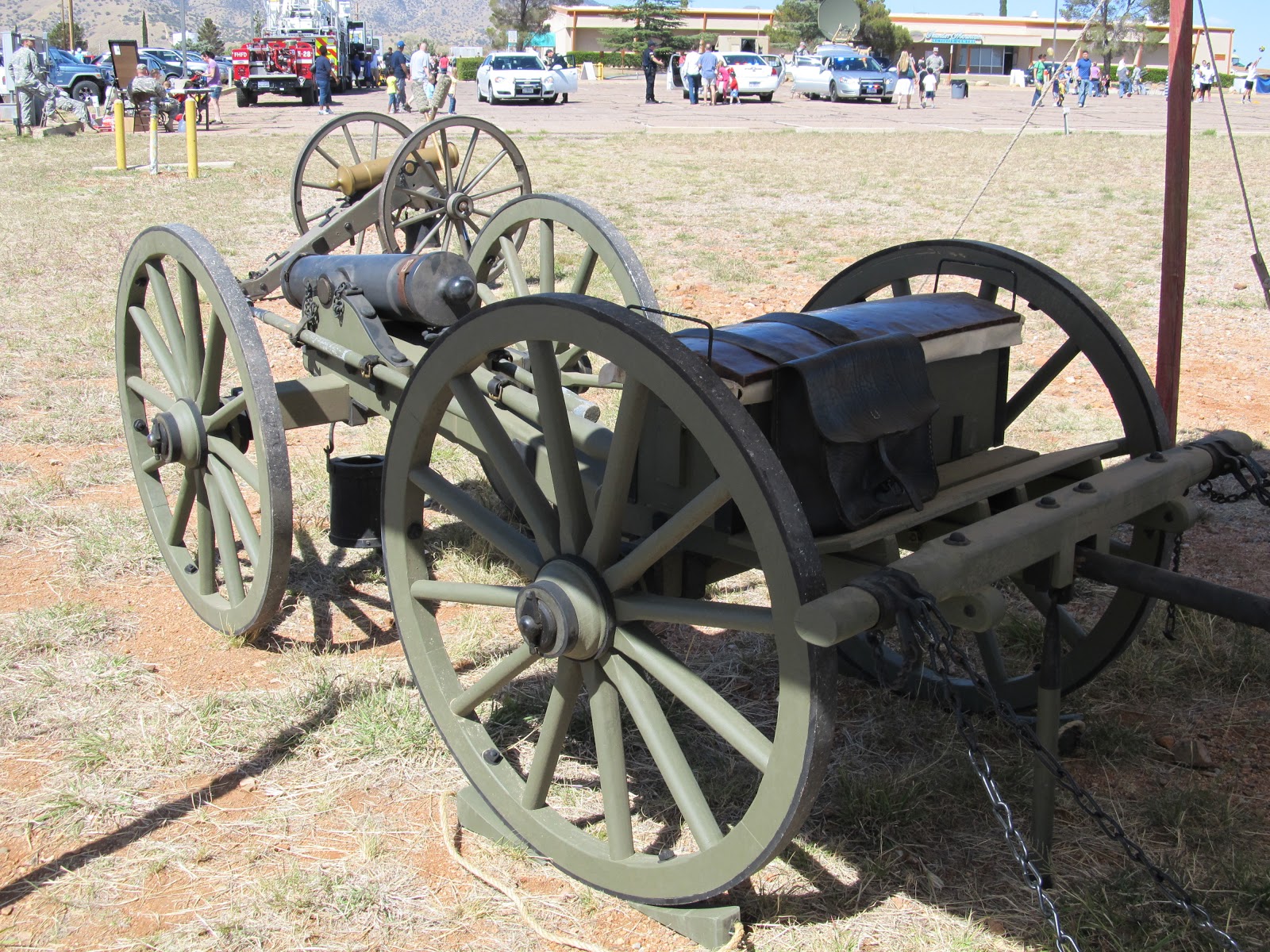
Mountain Howitzer Artillery Harness

On Saturday, B Troop was tasked to support Fort Huachuca's Celebration of the Military Child event--a festival of sorts for the local community.  The weather was excellent and a good crowd showed up to participate. 
The artillery harness on display
I had despaired that we would not have enough people to support the event, and at one point cancelled our participation.  We had only five people to support, of which only three were riders.  Not enough to put on a riding demonstration as we had been asked to provide.  However, the five people who signed up were committed and soon a few others began to sign on until we had a total of nine people on the team. 
 
We still didn't have enough riders to put on a show, so the troopers elected to set up a small saber course with which to demonstrate their riding skills.  In addition, a couple of ladies agreed to ride sidesaddle, and several of our cannon crew members set up a static display of their equipment. 
 
The two mountain howitzers
B Troop has had for many years an artillery harness for its 1840 mountain howitzer.  I moved it into storage years ago as we never used it and it was just taking up space.  However, in the last few months, our cannon crew has grown substantially and we welcomed a couple of experienced artillery reenactors, Donnis and Priscilla, who owned their own mountain howitzer.  I told them about the artillery harness that was gathering dust in our old mule barn and they were very interested in it.  They offered to clean it up and put it on display for the Military Child event. 
The B Troop encampment
 
What they accomplished in the space of five days was nothing less than miraculous.  The cleaned and oiled the entire harness set and had it on display in all its glory.  They also brought their own howitzer, complete with limber.  These two individuals are a great asset to B Troop and their enthusiasm and knowledge of all things artillery, is impressive.   Now we just have to train up a team of horses to pull the cannon and we can give the other Army horse detachments a run for their money.    


Saturday, April 13, 2013

Horse Bee Stings

One of our retired Army horses, Bandit, had a bad run in with some bees today.  I had put all the horses in the north pasture so I could unload some sand into the horse pens which are in the south pasture.  The horses were spending the afternoon happily nibbling at the new shoots of grass growing in the north pasture.  It was pretty peaceful save for a little fusing between Regent and Wyatt who is a retired Army horse on our neighbor's property.  Regent and Wyatt are old rivals and it was necessary to discuss a few things over the fence. 
 
Poor Bandit covered in bee stings. 
However, the afternoon calm was shattered by the sound of Bandit, who is lame, galloping madly for the gate to the south pasture.  Debbie heard all this and went out to find Bandit frantically trying to scrape his sides on the fence and kicking at himself.  She saw that he was covered in bee stings.  She let him through to the other pasture and led all the other horses over too.  Fortunately, none of the others had any stings.  Debbie put Bandit into a stall and tried to calm him down, but he was extremely agitated and didn't want her to touch him.  She gave him some antihistamines she had on hand and called the vet to see if there was anything else she could give him other than banamine for the pain. 
 
Bandit calmed down after a while and will spend the night in a stall until he feels better.  I went out into the pasture to see if I could find a hive, but found no sign of any bees.  Apparently a swarm had come through and Bandit just happened to be in the way.  I'm guessing they weren't Africanized bees or Bandit would probably be dead by now.  Its just one more thing you have to watch out for here in Arizona.

Thursday, April 11, 2013

More Horse Vaccination Reactions

After the incident yesterday with Ruger, we discovered four other horses having bad reactions to the vaccinations they received.  Apache, Blade, Duke, and Charlie were all found to be stocked up in their legs.  Duke was only stocked up on the back legs, but all the others experienced swelling in all four legs.  Charlie also developed swelling at the injections sites on both sides of his neck. None of the horses lost their appetite or became sick, but Charlie developed a slight fever for a while.  We're trying to determine if there is something wrong with the vaccine.  We have never experienced anything like this. 
 
The swelling on Charlie's neck
 

Wednesday, April 10, 2013

Horse Vaccination Reactions

Our horses were due for their vaccinations in March, but due to the bureaucracy associated with the new budget restrictions, the vaccines didn't make in until this week.  The mil vet, with her team, showed up this morning and jabbed all the horses (accept for Blade, who I had to hold during the injection).  I then sent an email message out to all the troopers to warn them to look for swelling or other reactions to the vaccines. 

Later in the afternoon while I was in the office, one of our ladies wandered in and started asking questions.  I may not have the exact words, but the conversation went something like this:

"So, a horse lies down when its tired and it lies down when its sick.  So how do you know the difference?"  she asked.

"Well, it depends on when the horse is laying down.  For instance, if your feeding and the horse is laying down, he's sick,"  I replied.

"Oh, well, I just tried to give an apple to Ruger, but he wouldn't take it," she said.

"Well, some horses don't like apples," I replied.  "Has he ever refused an apple before?"

"I don't remember if I ever tried before," she answered.  "He wouldn't even lift his head," she added. 

I was kind of distracted by some work I was doing on the computer, but as she went out of the office her words began to sink in a little.  I decided I'd better go out and see what was going on. 
 
Ruger, a couple years ago--just a little guy then.
 

Ruger was laying flat out on the ground in his stall.  He is a young horse, about five years old.  He's not the kind of horse that stays on the ground when someone walks into his stall.  I walked up to him and tried to harass him into standing up.  After a little bit of flapping my hat at his back, he struggled to his feet.  We put a halter on him and I took him over to the medicine shed to check his vitals.  I tried to give him an apple treat, but he wouldn't take it.  Normally, he snaps it out of your hand.  I checked is heart rate and temperature and found he was at 52 BPM and 101.5 degrees.  He had bowel sounds and was passing manure, so I figured it was a reaction to the vaccinations.  I called the mil vet and took him back to his pen.  We kept him up and walking around until the vet arrived.  While we walked him around, he developed bad diarrhea. 
 
The vet arrived and confirmed the vital signs we had found and I noticed then that his respiration's were up also.  He was desperate to lay down, but we kept him standing.  The vet gave him banamine and began to treat him for colic.  First, she stuck her arm up his backside to check for obstructions or twisting.  Everything seemed to be okay so they then tried to get a tube down his nose to pump water into him.  Ruger was pretty well sedated, but he was having none of that.  Unfortunately, he got a bloody nose in the process which was getting spattered all over everybody and every thing. 
 
They were never able to get the tube in him, but it didn't seem to be necessary.  All the trauma associated with their treatment efforts seemed to get him through the colic.  The banamine probably did the job as it usually does in cases like this.  Once the pain was gone, he started feeling hungry and normal again.  We took his food away per the vet's instructions, gave him electrolyte paste, and left him plenty of water.  He was looking pretty normal about 30 minutes later, so I stopped being concerned.  The vet promised to come back later to check on him. 
 
Just another dull day at the office.  It just goes to show that you have to sometimes read between the lines when someone is talking about horse behaviour.